About
Dialogue Café is the world's first public video conferencing network for civil society.
Dialogue Café is a global non-profit initiative that enables face-to-face conversations between diverse groups of people from around the world so that they can share experiences, learn from each other and work together to make the world a better place. This is the world's first public video conferencing network specifically for civil society - for social, educational and cultural organizations.
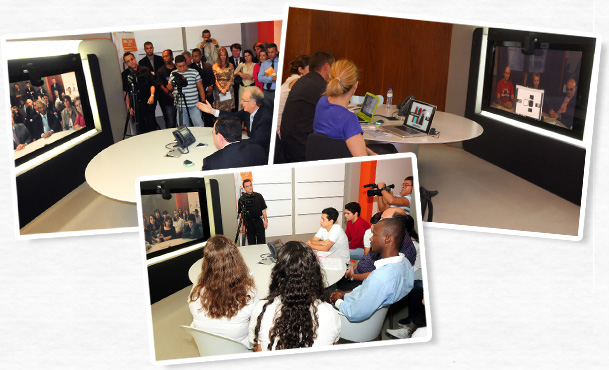
Dialogue Cafés are physical spaces based in city centres. They provide access to video conferencing technology and are connected through a global technology platform to enable city-to-city and multi-city conversations and activities.
Dialogue Cafés are open to civil society groups and organisations. This includes organisations with a social, environmental, educational or cultural mission - including foundations, associations, NGOs, community groups, universities, schools, social enterprises, public sector bodies and agencies.
Why was Dialogue Café created?
Dialogue Café is based on the radical but simple idea that people have many things in common and given the opportunity, they will explore their common interests, sparking collaborations and stimulating ideas that address the major issues of today.These kinds of conversations and collaborations can lead to new ways of thinking and doing: they can empower individuals and communities, break down prejudice and misconceptions and promote greater understanding and co-operation across cultures.
Despite rapid advances in communications technologies, there remain real barriers for civil society organisations, public sector organisations and social enterprises to share their work and learn from others globally. Dialogue Café hopes to bridge this divide and enable civil society organisations and others to collaborate, thereby enhancing understanding between different cultures and societies and promoting social and economic development.
What's different about Dialogue Café?
Dialogue Café is a low cost, low carbon way of connecting to people in other parts of the world. It also provides a unique experience. The technology we use at Dialogue Café, TelePresence, links people through life-size high definition video and sound, allowing them to talk and meet in real time despite being located on different sides of the world. As such, Dialogue Café plays a role as a bridge to the rest of the world: it enables local hosts, and local civil society groups, to share their work, knowledge and ideas and learn from others from around the world.
There are lots of ways to get involved!
You can come to our public events. Have a look at Our Network and the blog for information about upcoming talks, lectures and seminars.
You can book out the Dialogue Cafés for your own events. Want to connect to colleagues in other cities? Want to organise a global workshop? Want to organise a lecture with leading thinkers in other parts of the world? Get in touch with the Dialogue Café Managers.
You can help us bring a Dialogue Café to you. We're working with people and organisations around the world to grow the network of Dialogue Cafés. If you want to be involved in bringing Dialogue Café to your city or helping local partners to set up a Dialogue Café then get in touch with sara.piteira@dialoguecafe.org
The Dialogue Café Association does not promote or discriminate against any person, population group, or organization on grounds including, but not limited to ethnicity, religion, sex, gender, language, education, background, national origin, age or disability.
Latest from our blog 
- World Poetry Day: Celebrating our common humanity
Mar 24, 2021
- International Women�s Day #ChooseToChallenge
Mar 3, 2021
- Entrepreneurship, Creative Hubs & Makers: innovation and resilience in pandemic times
Feb 23, 2021
- Recover Better ? Stand Up for Human Rights
Dec 7, 2020

A decision to proclaim 21 March as World Poetry Day was adopted during UNESCO’s 30th session held in Paris in 1999 with the objective to support linguistic diversity through poetic expression and to offer endangered languages the opportunity to be heard within their communities.
Since 1999, every year on 21 March, the World Poetry Day celebrates one of humanity’s most treasured forms of cultural and linguistic expression and identity. Poetry is a driver of common humanity and shared values, a powerful catalyst for dialogue and peace. The World Poetry Day serves also to honour poets, revive oral traditions, promote poetry and especially, bring people together across continents.
Against this backdrop, Dialogue Café Network is organising a session to celebrate our common humanity and values and promote intercultural dialogue through poetry. With this purpose, poets from Serbia, Portugal and other countries will be invited to join this session, share their poems in their mother tongue and translate them into English to the audience in an open dialogue and exchange. People interested in joining the session would be able to share poems with the participants to celebrate our common humanity.
The session will be held on 25 March 2021 from 3pm – 5pm London time and will join participants from Portugal, Serbia and Spain.
- Graça Melo – Portuguese Association of Poetes – Portugal
- Ersan Muhović – Poet and writer, Serbia
- Zilha Ragipović – Poet, Serbia
- Emina Marukić – Last year’s laureate of the Duga’s poet competition, Serbia
- Selma Kolašinac – Poet reciter, Serbia
JOIN IN!
For further information and registration:
Dialogue Café Lisbon – Dalia Sendra (daliasendra@casadoregalo.pt)
Dialogue Café Novi Pazar – Haris Imamovic (imamovicharis@hotmail.com)
Dialogue Café Évora – Ana Rita Valido/ADRAL (ana.valido@adral.pt)
]]>
Since 1911, annually on March 8th, the International Women’s Day (IWD) is marked to celebrate globally the social, economic, cultural and political achievements of women, raise awareness about women’s equality and fundraise for female-focused charities. The day also marks a call to action for accelerating gender parity. Significant activity is witnessed worldwide as groups come together to celebrate women’s achievements or rally for women’s equality.
According to the World Economic Forum, sadly none of us will see gender parity in our lifetimes, and nor likely will many of our children. Gender parity will not be attained for almost a century.
The focus of IWD in 2021 is about choice, the choice of challenging our thoughts and actions every day with the aim of creating, collectively, an inclusive world, a better world for all of us.
From challenge comes change, so let’s all choose to challenge.
Against this backdrop, Dialogue Café Network is organising a session to celebrate women´s achievements, raise awareness about women´s equality and support gender parity. Wth this purpose, women from all ages, sectors and cities involved will be invited to join this session, celebrate the IWD and address questions raised during the debate such as:
- How will you help forge a gender equal world?
- How better to raise awareness against bias and stereotypes?
- According to your knowledge and experience how do you think the pandemic has affected the path for equality?
- How are younger generations assuming the challenge of gender equality?
- Share a woman’s achievement.
- Share an example of small action we all can undertake for equality.
- Share a motto for equality
PROGRAMME
Dialogue Cafe Belgrade (United Nations Associations of Serbia)
- Sanja Petrovic, Lawyer
Dialogue Cafe Évora (Eugenio de Almeida Foundation/ADRAL)
- Tânia Salgado, President of the Board of ADDHG – Association for the Defense of Human Rights of Guimarães
- Alexandra Luís, Mulheres Sem Fronteiras
- Laura Quitério, LGBTI, Leiria
- Joana, Centre of Culture and Feminist Intervention
Dialogue Café Novi Sad (Youth Office)
- Branislava Aradjan, President, Junior Chamber International , JCI Novi Sad
#ChooseToChallenge #IWD2021
JOIN IN!
For further information and registration: Dialogue Café Lisbon – Dalia Sendra (daliasendra@casadoregalo.pt), Dialogue Café Belgrade – Biljana Vukosavljevic (unaserbia@gmail.com), Dialogue Café Cidade de Praia – Indira Pires (ipires@institutopedropires.org.cv), Dialogue Café Évora – Margarida Oliveira/FEA (margarida.oliveira@fea.pt) & Ana Rita Valido/ADRAL (ana.valido@adral.pt), Dialogue Café Novi Sad – Stefan Radojcic (s.radojcic@pf.uns.ac.rs)
]]>
Creative hubs represent a tool for innovation and a guide to entrepreneurs to bring social value to societies and communities through their creativity on local and global scale.
As the UNCTAD report (2010) states, creative economy has the potential to generate wealth and jobs while promoting social inclusion and human development. They facilitate the creative process of entrepreneurs by providing space, consultation, training, funding. Moreover, creative hubs represent a place where young entrepreneurs and start-ups from different backgrounds can meet, discuss, develop and implement new ideas, to building up a new environment able to empower different social groups and support their inclusion.
On the other hand, entrepreneurs and makers bring new ideas and dreams to explore within creative hubs, enhancing the heritage and knowledge of those spaces. In COVID-19 times, where entrepreneurs and makers need to be more resilient and creative hubs pursue innovation more than ever, spaces and opportunities to share knowledge, jointly analyse challenges and approach solutions will be excellent ways to surpass the negative impact the pandemic will bring at the social and economic level.
Against this backdrop, Dialogue Café Network is organising a session to address the successfulness factors and practices implemented by creative hubs to support entrepreneurs and makers and provide responses to their needs. During the sessions some questions will be raised such as:
- How has the COVID-19 affected entrepreneurs and makers?
- According to your knowledge and experience, in which sense creative hubs can provide new opportunities to entrepreneurs and makers?
- How to promote innovation and resilience at the entrepreneurial level in the new era?
- Working together is essential to recover from this global crisis. From entrepreneurs and makers, to creative hubs, authorities and other third sector organisations to the private sector, we all have a role in building a post-COVID world that is better for present and future generations. Kindly share your opinion and views on how better encourage collaboration and co-creation within creative hubs among entrepreneurs and makers. Share your opinion, experience and knowledge.
Provisional Programme
Dialogue Café Belgrade (United Nations Associations of Serbia)
- Jugoslav Stanković, General Manager, Think Innovative
Dialogue Cafe Évora (Eugenio de Almeida Foundation)
- Antonieta Félix, Entrepreneur of Project “Literacia”
- Carlos Ramos, Founder of “B de Brincar”
- Tânia Carvalho, Founder of “INHERVOICE”
Dialogue Cafe Novi Pazar (Centar Duga)
- Vesna Sekulić, creative worker & CEO “Zvechka”
- Lejla Mulić, creative worker & CEO “LeCreative Gift Shop”.
And much more!
KEEP POSTED!
]]>
Human Rights Day is observed every year on 10 December — the day the United Nations General Assembly adopted, in 1948, the Universal Declaration of Human Rights (UDHR). The UDHR is a milestone document that proclaims the inalienable rights which everyone is entitled to as a human being – regardless of race, colour, religion, sex, language, political or other opinion, national or social origin, property, birth or other status. The focus of the Human Rights Day 2020 is Recover Better – Stand Up for Human Rights. 2020 theme is related to the COVID-19 pandemic and focuses on the need to build back better by ensuring Human Rights are central to recovery efforts. As Human rights are at the heart of the Sustainable Development Goals (SDGs), we cannot hope to drive sustainable development in the absence of human dignity. To reach the SDGs, equal opportunities for all should be created, failures exposed by Covid-19 pandemic addressed and human rights standards applied to tackle systematic inequalities, exclusion and discrimination.
Against this backdrop, Dialogue Café Network is organising a session to celebrate the Human Rights Day and reaffirm the importance of human rights in re-building a new world based on global solidarity, interconnectedness, solidarity and equality. Special guests invited to analyse how the Covid-19 pandemic is rising poverty, inequalities, discrimination and other gaps in human rights protection as well as to share their views and motivations on how better recover from the effects of this global pandemic and propose measures to recover and build back a better world, more resilient, just and sustainable.

Some of the questions to be raised during the debate will be:
- According to your knowledge and experience, in which sense the Covid-19 pandemic has affected Human Rights?
- Has the covid-19 crisis fuelled structural discrimination and racism? If yes, how?
- What measures can be proposed in order to end discrimination of any kind in a post-Covid world?
- In which way Covid-19 pandemic has affected, already existing, inequalities? How to promote and protect economic, social and cultural rights in the new era?
- Working together is essential to recover from this global crisis. From individuals to governments, from civil society and grass-roots communities to the private sector, we all have a role in building a post-COVID world that is better for present and future generations. Kindly share your opinion and views on how better encourage participation and solidarity. Share your opinion about best measures to ensure all voices are heard in this process, especially the voices from the most affected and vulnerable.
- Sustainable development is a must. The association between Human Rights and the 2030 Agenda is unalienable. How to act in order to ensure no one is left behind?
PROGRAMME
Dialogue Cafe Belgrade
- Uros Andjelkovic, Serbian Youth Delegate to the UN (Moderator)
- Katarina Velkov, MA in Human Rights and Multi-level governance
Dialogue Cafe Novi Pazar / Centar Duga
- Ajša Šukurica, NGO “Tavus”
Dialogue Café Novi Sad:
- Stefan Radoičić, Teaching Assistant at the Law Faculty, University of Novi Sad.
JOIN IN!
]]>
By United Nations General Assembly (UNGA) mandate, the International Volunteer Day (IVD)[1] is celebrated annually on 5 December with the aim of celebrating volunteers and organisations efforts, promote their values and disseminate their work.
The focus of the IVD 2020 is “Together We Can Through Volunteering” in order to highlight the role of volunteers in raising awareness, inspiring others and achieving the SDGs.
“the efforts of 1 billion volunteers is an important foundation at a pivotal moment for development to enable us to recover from the COVID-19 pandemic”
(UN Deputy Secretary General Amina J. Mohammed)
During the COVID 19 pandemic, volunteers have been at the forefront of medical, community and societal responses. Community volunteers are recognised by the World Health Organisation as key stakeholders for risk communication and community engagement. Their effort during the covid-19 pandemic has been huge and should be further recognised. IVD2020 is dedicated to volunteers worldwide and aims at recognising their valuable contribution.
As per initiative of the Eugenio de Almeida Foundation, host of Dialogue Cafe Évora room, Dialogue Café members in Belgrade, Evora, Novi Sad and Lisbon will organise a session on volunteering with the aim of celebrating volunteer effort and recognising their contribution to the community in those harsh times. During the session, volunteers and social organisations invited will analyse the difficulties confronted by volunteers in times of covid-19 as well as identify new opportunities and frames for volunteering. Volunteers participating in the session will share also their views, motivations and experiences to show the benefits of volunteering.
Some of the questions to be raised during the debate are:
- According to your experience, how the Covid-19 pandemic has affected volunteering?
- What are the most important challenges faced by volunteers in the new era Covid-19?
- How social distancing and restrictions imposed has affected your work as volunteer?
- What about digital technology? Kindly let us know how the Covid-19 pandemic has affected the use of digital technology in your work as volunteer?
- Every crisis brings challenges, but also opportunities. Please identify new opportunities of volunteering brought by the new reality Covid-19 pandemic.
- How do you see volunteering in the near future?
- Share your best volunteering experience.
Check out the provisional programme and keep posted to know more!
Moderation: Inês Gonçalvez, Volunteers´Manager, Eugenio de Almeida Foundation
Dialogue Cafe Belgrade / Youth Office
- Sonja Kuzman, Volunteer at the Novak Djoković Foundation
- Marija Stojanović, Red Cross Stari Grad
Dialogue Cafe Évora / ADRAL
- Maria João Rosado, Volunteer
- Alexandra Mota, National Association of Young Entrepreneurs
Dialogue Cafe Évora / Eugénio de Almeida Foundation
- Gil Nobre, Cultural volunteer at Eugenio de Almeida Foundation and Volunteer at the High School Gabriel Pereira Club
- Filipa Neves, Project Mind the Mind and National Association of Psychology Students
- Francisca Sousa, Comission of Volunteer, Food Bank Against Hunger, Évora
- Levi Filho, Cultural Volunteer and Volunteer at the Social Kitchen of the Eugenio de Almeida Foundation
- Sandra Veladas, Volunteer at the Social Kitchen of the Eugenio de Almeida Foundation
Dialogue Novi Sad / Youth Office
- Dr. Branka Cvetanović, OPENS – European Youth Capital Novi Sad
JOIN IN!
]]>
Celebrating the Global Entrepreneurship Week 2020
& Women’s Entrepreneurship Day (WED)
25 November 2020 | 3pm – 5pm London time
Belgrade, Evora, Lisbon, Novi Sad
Entrepreneurship is an important driver of economic growth and it provides economic opportunities everywhere.
Despite women entrepreneurs are to make a greater impact across economies, only 34.4 % of the European Union (EU) self-employed and 30 % of start-up entrepreneurs are women. In order to increase women´s participation in economy and entrepreneurship, special policy attention is needed on matters including but not limited to education, and non-discrimination, in areas such as access to finance and property rights.The OECD Recommendation on Gender Equality calls on governments to reduce the gender gap in entrepreneurship activity and support women entrepreneurs in confronting issues and strengthening the necessary skills to their success. Women´s full and effective participation and equal opportunities for leadership at all levels of decisionmaking, including the economic, as well as to give women equal rights to economic resources, as well as access to ownership and control over financial services are some of the targets established by the Sustainable Development Agenda 2030.
In order to support women´s entrepreneurs and celebrate the Women´s Entrepreneurship Day 2020, Dialogue Café network will organise a specific session on Micro and Small Business led by Women in the framework of the Exchange of Businesspersons and Entrepreneurs organised by our partners in Évora, the ADRAL Regional Agency for the Development of the Alentejo region and the Europe Direct Initiative.
The session, which will take place on 25th November from 3pm to 5pm London time, aims at sharing businesswomen knowledge, supporting women´s entrepreneurs and promoting networking within the Women’s Entrepreneurship Day (WEDO) global movement.
Businesswomen and women´s entrepreneurs invited to the online discussion will share experiences, views and testimonials as well as will address the following questions as well as other raised during the session:
- What led you to follow your own project?
- Why do you think there is still such a big difference in the gender of entrepreneurs?
- What were the main difficulties you have faced as entrepreneur, as women entrepreneur? If you have come across some.
- What are the major challenges that women face in micro and medium business?;
- What are the business skills all women entrepreneurs need to develop to achieve success?;
- Share a tip about entrepreneurship
- Best business models;
- The role of cooperation and networking in business development.
Programme
- Tânia Oliveira, Creative Thinkers
- Tânia Gomes, Meduse
- Joana Fialho, Crossmind box
- Cristina Faria, Founder of Lead Yourself and Consulting on organisational development
- Nade Mašić, Member of Association of Business Women in Serbia (Founder “Children house – Love, hope, faith”)
- Belizanda Quintos, Picos D´Sabor
- Esther Cano, Omicron
JOIN IN!
]]>
The COVID-19 pandemic marked a disrupting point for the world, compounded by an unprecedented global health crisis with severe economic and social impacts that highlighted existing inequalities and differences. Low income neighbourhoods are more likely to be hit by coronavirus cases and its negative impact. and impact as most of them may lack access to health care, lost their jobs and became unemployed.
At the beginning of 2020, the path towards the achievement 2030 SDG Agenda was on track and the global community committed to accelerate efforts and sustainable solutions to the world’s biggest challenges, ranging from eradicating poverty and reducing gender inequality to addressing climate change. However, in only some months, the COVID-19 pandemic brought an unprecedented situation and threatens to reverse years of progress on the global goals, on poverty, hunger, health care and education. While the virus has impacted everyone, it is especially affecting the most vulnerable people.
Urgent and innovative responses are needed to surpass this period of crisis but people should be at the centre of these solutions to achieve more equitable and sustainable outcomes for all. Against this backdrop, the community has played an exceptional role in the social response to the global pandemic by providing care and attention to the most vulnerable and affected.
In this sense, Dialogue Café Network would like to address the role of the community/communities in times of COVID-19 pandemic especially with regard to the impact of its action in social cohesion.
Guests invited to the online discussion will share experiences, views and testimonials with this regard as well as address the following questions:
- What is the role of different communities for the social cohesion of territories in times of pandemic?
- What are the urgent and innovative responses that are needed to overcome this period of crisis?
- Is the unity of communities essential to change?
- Are community responses sufficient to have an impact?
The session will be also a unique opportunity to celebrate the 2nd anniversary of Dialogue Café Room at the Eugenio de Almeida Foundation in Evora (Portugal), which has an extensive work of community support.
The session will take place next Monday 16th November from 15h to 17h London time through ciscowebex videoconference system.
Provisional programme:
PROGRAMME
Dialogue Cafe Belgrade
- Lidija Bukvic Brankovic, CEPORA Belgrade (Serbia)
Dialogue Cafe Évora
- Joana Good da Silva, Volunteer at Eugenio de Almeida Foundation, Évora (Portugal)
Dialogue Cafe Lisbon
- Noémia Certo Simões, Professor, Volunteer at Animar – Deseenvolvimento local and Bué fixe organisations
Dialogue Cafe Novi Sad
- Aleksa Stanišić (Communication and marketing Coordinator), Volunteer center of Vojvodina, Novi Sad (Serbia)
JOIN IN
&
SHARE YOUR EXPERIENCE IN AND FOR THE COMMUNITY!
]]>
Our planet is drowning in plastic pollution (UN Environment Agency)
The Climate Crisis – A Race We Can Win #UN75: Sustainable cities and Plastic-free lifestyle
2020 is the 75th anniversary of the United Nations. In this framework an initiative for promoting dialogue in main global issues was launched to celebrate it along the year. Despite the COVID-19 pandemic marked a disrupting point for the world, compounded by an unprecedented global health crisis with severe economic and social impacts, climate emergency remains one of the most important challenges. The Sustainable Development Agenda urges us to take action to combat climate change (SDG13) which will affect more than 39 million people. Plastic pollution exacerbates climate change and represents a dangerous thread to biodiversity as plastic needs 100 years to degrade in the environment.
According to the World Economic Forum plastic production is expected to double by 2040. Each year, 17,000,000 barrels of oil are used to produce plastic, including 500,000,000,000 plastic bags used yearly. By 2030, greenhouse gas emissions from plastic could reach 1.34 billion tons per year what will affect our capacity to keep the global temperature rise below 1.5˚C. Plastic pollution threats ocean health and marine life as has a strong impact on food safety and quality and human health. Annually, 13,000,000 tonnes of plastic are leak into the ocean and 100,000 marine animals are killed by plastics. Current scientific studies are determining how microplastics can affect phytoplankton’s ability to sequester carbon dioxide.
We need to switch the paradigm and urgent action is needed from the industrial sector but from citizens as well. Single-use plastic products are everywhere and became integral to our daily lives. Actions to slow the flow of plastic at its source and its consumption as well as to improve plastic waste management are needed.
Against this backdrop, Dialogue Café Network would like to join the #U75 discussions promoted by the UN and to address the challenge of plastic pollution by raising citizens awareness and supporting the swift to plastic-free lifestyles.
Guests invited to the online discussion will share policy guidelines, examples of initiatives and advice for reaching plastic-free lifestyles.
Among the participants confirmed:
- Andreia Morita, Europe Direct Alentejo Central e Litoral, ADRAL
- Micaela Thurman, OSCE Mission to Serbia‘s Project Manager
- Uros Andjelkovic, Serbian Youth Delegate to the UN
With the participation of Dialogue Cafe Novi Sad and Dialogue Cafe Lisbon.
The session will take place on Tuesday 10th November 2020 from 15h to 17h London time via cisco webex videoconference system.
Keep posted for further information about the programme.
JOIN IN AND SHARE YOUR IDEAS!
For further information and registration: Dialogue Café Lisbon – Dalia Sendra (daliasendra@casadoregalo.pt), Dialogue Café Belgrade – Biljana Vukosavljevic (unaserbia@gmail.com), Dialogue Café Cidade de Praia – Indira Pires (ipires@institutopedropires.org.cv), Dialogue Café Évora – Margarida Oliveira/FEA (margarida.oliveira@fea.pt) & Ana Rita Valido/ADRAL (ana.valido@adral.pt), Dialogue Café Novi Pazar – Haris E. Imamović (Haris Imamovic imamovicharis@hotmail.com), Dialogue Café Novi Sad – Stefan Radojcic (s.radojcic@pf.uns.ac.rs)
Sources: https://www.unenvironment.org/interactive/beat-plastic-pollution/; https://blogs.ei.columbia.edu/2020/02/20/plastic-production-climate-change/; https://www.iucn.org/
]]>
2020 is the 75th anniversary of the United Nations. In this framework an initiative for promoting dialogue in main global issues was launched to celebrate it along the year. However the COVID-19 pandemic marked a disrupting point for the world, compounded by an unprecedented global health crisis with severe economic and social impacts. In these harsh times, more than ever global governance and leadership should be strengthened in order to build a better future for all.
In this framework, Dialogue Café Network would like to join the #U75 discussions promoted by the UN and address the role of global governance in times of uncertainty in which “public trust in traditional institutions is in decline and relations between countries have been under strain” (UN), through the following questions, some of them proposed by the United Nations, and other proposed by participants in the discussion:
i) Will we emerge stronger and better equipped to work together?, or will distrust and isolation grow further;
ii) How better can we promote cooperation across borders, sectors and generations?;
iii) Will the COVID-19 pandemic determine the achievement of the Sustainable Development Goals?;
iv) Which are the best solutions and measures to navigate Europe’s economy through the crisis provoked by the covid-19 pandemic?
v) Which role should play the United Nations? What about other international, or regional organisations?
The session will be an opportunity to celebrate the international day of UN on 24 october 2020.
Keep posted to know more about the programme.
Join the us and share your experience and ideas!


The UN General Assembly each 21 September as a day devoted to strengthening the ideals of peace. The International Day of Peace 2020 is dedicated to “Shaping Peace Together” and aims to celebrate compassion, kindness and hope in world frightened by COVID-19 pandemic. A special moment that the United Nations celebrates in the framework of its 75th anniversary and a programme of global conversations aimed at building the peaceful and prosperous future that we all want.
Dialogue Café Network will commemorate the International Day of Peace by organising a global debate on the role of youth in peacebuilding to foster dialogue and collect ideas.
Young people will be invited to share thoughts on how to weather this storm, heal our planet and build peace[1] and debate on the following questions raised by UN and other proposed by participants during the exchange:
- What does peace mean to you?
- When you envision a peaceful world, what do you see?
- What actions are needed to make your vision a reality?
- What role can you play in that regard?
- How can prevent conflicts in the first place?
- How can we tackle conflicts?
- It´s peace is declared, how can it be sustained?
The debate will be moderated by a member of Dialogue Café Network through questions and the exchange of experiences. External participants will have the possibility of sharing their questions through chat to experts and guest involved but registration is mandatory. Otherwise interested participants can attend the event via livestreaming. The debate will take place via Dialogue Café videoconference system provided by CISCO Webex.
Provisional programme
Dialogue Cafe Evora
- Manuel Marchante, 100% ADN Association
Dialogue Cafe Belgrade:
- Muhamed Alyatem, Master degree Peace Studies at University of Belgrade
- Uros Andjelkovic, Serbian UN Youth Delegate
Dialogue Cafe Novi Sad:
- Velimir Milošev, Young European Ambassador
Keep posted for further information|
For further information and registration:
Dialogue Café Lisbon – Dalia Sendra (daliasendra@casadoregalo.pt), Dialogue Café Belgrade – Biljana Vukosavljevic (unaserbia@gmail.com), Dialogue Café Cidade de Praia – Indira Pires (ipires@institutopedropires.org.cv), Dialogue Café Évora – Margarida Oliveira/FEA (margarida.oliveira@fea.pt) & Ana Rita Valido/ADRAL (ana.valido@adral.pt), Dialogue Café Novi Sad – Stefan Radojcic (s.radojcic@pf.uns.ac.rs)
[1] United Nations – https://www.un.org/sites/un2.un.org/files/idp_what_you_can_do_to_help_-_one-pager.pdf
]]>Sign up for updates
Connect with us on...